
The first half of 2026 has reinforced a reality that many business leaders have been experiencing for several years: supply chain disruption is no longer an occasional event. It has become a permanent feature of the operating environment.
For CFOs, CEOs and Procurement leaders, the challenge is no longer simply securing supply or reducing costs. The focus has shifted towards protecting margins, managing risk, maintaining operational resilience and ensuring supplier performance in an increasingly volatile market.
Whilst organisations have become more resilient since the pandemic, a new wave of disruption is placing pressure on costs, supplier relationships and commercial performance.
In this article, we explore the key procurement and supply chain challenges affecting UK businesses in 2026 and the practical steps organisations can take to mitigate their impact.
-
Global Trade Uncertainty and Tariff Volatility
Changes to international trade policies and tariff structures have created uncertainty across global supply chains. Even organisations that do not trade directly with affected regions are experiencing indirect consequences through increased supplier costs, fluctuating commodity prices and disrupted sourcing strategies.
Many suppliers are reducing the validity period of quotations, introducing price review mechanisms and passing increased costs through to customers.
Potential Impact
- Increased procurement costs
- Margin erosion
- Reduced forecasting accuracy
- Supplier instability
- Increased sourcing complexity
Mitigation Strategies
Organisations should focus on developing greater visibility across their supplier base and reducing dependency on single-source suppliers.
Key actions include:
- Conducting supplier risk assessments
- Identifying alternative suppliers and supply routes
- Introducing strategic sourcing programmes
- Reviewing contract pricing mechanisms
- Strengthening supplier relationship management processes
The businesses best positioned to manage future trade disruption are those that have already diversified supply and established contingency plans.
-
Geopolitical Instability and Rising Logistics Costs
Ongoing geopolitical tensions continue to impact transportation networks, fuel prices and international shipping routes.
Whilst the impact varies by sector, many organisations are experiencing increased freight costs, extended lead times and greater uncertainty around supply continuity.
Potential Impact
- Higher transportation costs
- Increased inventory requirements
- Reduced service levels
- Delayed projects and deliveries
Mitigation Strategies
Businesses should review supply chain resilience rather than focusing solely on lowest-cost sourcing.
Practical measures include:
- Reviewing inventory strategies for critical items
- Implementing demand forecasting improvements
- Evaluating nearshoring opportunities
- Developing business continuity plans
- Creating supplier contingency frameworks
The cost of resilience is often significantly lower than the cost of disruption.
-
Persistent Inflation Across Labour and Services
Whilst product inflation has moderated in some sectors, labour costs, outsourced services and operational expenditure continue to increase.
Many organisations have already completed traditional cost reduction programmes and are now searching for new opportunities to protect profitability.
Potential Impact
- Increased operational expenditure
- Reduced EBITDA performance
- Pressure on budgets
- Increased supplier pricing requests
Mitigation Strategies
Rather than focusing solely on cost reduction, organisations should pursue value optimisation.
This includes:
- Reviewing supplier performance against agreed contracts
- Benchmarking pricing and service levels
- Consolidating suppliers where appropriate
- Renegotiating commercial terms
- Implementing ongoing spend management programmes
Procurement should be viewed as a continuous value creation function rather than a one-off savings exercise.
-
Cybersecurity and Third-Party Risk
As businesses become increasingly reliant on digital systems and outsourced service providers, cybersecurity has evolved into a supply chain issue.
A cyber incident affecting a critical supplier can disrupt operations just as severely as a physical supply chain failure.
Potential Impact
- Operational disruption
- Financial losses
- Regulatory exposure
- Reputational damage
- Business continuity risks
Mitigation Strategies
Supplier risk management should now include cybersecurity assessments alongside traditional financial and operational reviews.
Organisations should consider:
- Introducing supplier cybersecurity evaluations
- Reviewing contractual security requirements
- Assessing critical supplier dependencies
- Implementing regular supplier risk reviews
- Strengthening governance processes
Supply chain resilience now requires both physical and digital risk management.
-
Economic Uncertainty and Margin Pressure
Many organisations are facing a difficult combination of slower growth, increased operating costs and continued investor pressure to improve profitability.
This environment is driving renewed focus on cash generation, working capital management and operational efficiency
Potential Impact
- Reduced profitability
- Increased pressure on finance teams
- Greater demand for cost control
- Delayed investment decisions
Mitigation Strategies
Leading organisations are increasingly adopting a proactive procurement model focused on measurable business outcomes.
Areas of focus include:
- Spend visibility and analytics
- Contract compliance management
- Supplier performance monitoring
- Working capital optimisation
- Procurement transformation programmes
The objective is not simply to reduce spend but to maximise value from every supplier relationship.
Why Procurement Has Become a Strategic Function
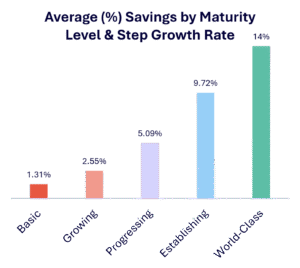
The most significant change in 2026 is not the individual disruption events themselves.
It is the growing recognition that procurement sits at the intersection of cost management, risk management, operational resilience and supplier performance.
The organisations outperforming their peers are those that view procurement as a strategic capability rather than an administrative function. A recent study by our sister company, 4CAssociates, highlights this in their Procurement Maturity research published in conjunction with University of Birmingham. Their findings show that organisations with mature Procurement functions generate far more savings than any other degree of maturity (Figure 1; 4CA, 2025).
Their findings are compounded by Gartner’s discovery that supplier segmentation prioritisation has skyrocketed in importance in the last 24 months, with 88% of CPOs agreeing it is a top priority for their organisations (Gartner, 2026).
By implementing structured supplier management, strengthening governance and maintaining visibility across spend and contracts, businesses can create resilience whilst continuing to improve financial performance.
How Managed Procurement Services Can Help
Many organisations recognise the opportunities within procurement but lack the internal capacity, specialist expertise or analytical resources needed to drive sustained improvements.
Managed procurement services provide access to procurement professionals, category expertise, supplier management capability and ongoing governance across the breadth of spend without the cost of building large internal teams.
By combining strategic sourcing, supplier performance management and continuous value delivery, organisations can:
- Improve EBITDA performance
- Reduce supplier risk
- Increase contract compliance
- Strengthen supplier relationships
- Enhance operational resilience
- Create sustainable cost savings
Above all, outsourced procurement can help organisations increase their procurement maturity by building long-lasting, sustainable processes. This is reinforced by The Hacket Group’s discovery that world-class procurement organisations generate approximately 9x ROI (purchase-cost savings relative to procurement operating costs), highlighting a strong link between measurement discipline and value delivery (The Hackett Group, 2026).
In today’s environment, procurement is no longer simply about buying goods and services. It is about protecting profitability, reducing risk and enabling business growth.
Businesses embracing this approach will be best positioned to navigate the challenges to come in the second half of 2026.
Citations:
Gartner (2024) “Gartner for Supply Chain Leaders 4 Ways to Better Manage Your Complex Supply Base”. Gartner Peer Insights. Available at: 4-ways-to-better-manage-your-complex-supply-base.pdf. Accessed on 25 June 2026.
4CA (2025). Transformative Procurement Annual Report 2025. 4CAssociates & University of Birmingham.
The Hackett Group (2026) “Procurement Benchmarking”. The Hackett Group. Available at: https://www.thehackettgroup.com/sourcing-procurement-strategy/sourcing-procurement-benchmarking/. Accessed on 25 June 2026.