
Supplier segmentation sits at the heart of effective procurement strategy, fundamentally determining how an organisation allocates its attention, resources, and risk management effort across its supply base.
Despite this, supplier segmentation one of the most inconsistently defined and applied concepts across organisations. At its core, supplier segmentation is the process of categorising suppliers based on factors such as strategic importance, risk exposure, spend, and relationship value, enabling organisations to allocate resources and management attention appropriately (Procurement Journey, n.d.; Kodiakhub, 2025). As supply chains become more complex, risk-laden, and strategically significant, the ability to differentiate suppliers – not just by spend, but by value, capability, and potential – is mission critical.
This guide brings together perspectives from across EBIT Intelligent Procurement’s Delivery, Operations, and Growth teams, capturing a multidimensional view of supplier segmentation in practice. By drawing on expert insight across strategy, execution, and transformation, this guide moves beyond theory to explore how segmentation is defined, challenged, and applied in real-world procurement environments. Rather than presenting a single “correct” answer, it reflects a synthesis of viewpoints, highlighting both alignment and divergence, offering a more grounded and practical understanding of supplier segmentation as a dynamic, decision-shaping capability.
Overview of Survey-Base
The surveyed EBIT team members represent a broad spread of experience levels, with 40% having 17+ years’ experience, and the remaining 60% evenly distributed across early- (ie; 0-7 years) and mid-career (7-17 years) stages. The sample is operationally grounded, with 50% focused on procurement operations, 30% in category management and strategy, and 20% in growth or transformation-oriented roles.
Crucially, all respondents had exposure to supplier segmentation: 30% have led initiatives, 50% have actively contributed, and 20% are familiar with the concept, ensuring the insights are strongly rooted in practical, hands-on experience.
Defining Supplier Segmentation
Across the survey responses, supplier segmentation is consistently understood as a mechanism for prioritisation, but the emphasis placed on that mechanism varies depending on perspective. At its core, respondents align with the view that segmentation is about categorising suppliers based on risk, value, and strategic importance to direct the right level of attention and management. This reflects industry-established definitions, positioning segmentation as a way to allocate resources effectively and tailor supplier management approaches according to business impact (Procurement Journey, n.d.; Kodiakhub, 2025).
However, the survey and team perspectives from Nicki Perrott, (COO), Paul Mills, (Head of Growth), and Gemma Bridle, (Head of Procurement Delivery) highlight meaningful differences in how this is interpreted in practice. The Delivery perspective frames segmentation as a structured, strategic exercise—focused on determining where to invest, collaborate, and apply governance based on supplier criticality. The Operations perspective, by contrast, emphasises practical prioritisation, using segmentation to clearly identify what can be deprioritised and how day-to-day procurement effort should be allocated. Meanwhile, the Growth perspective positions segmentation through a commercial lens, focusing on how it helps organisations direct time and investment towards suppliers that deliver the greatest commercial, operational, and risk mitigation impact.
Taken together, these perspectives reinforce that supplier segmentation is not a single, fixed concept, but a flexible capability shaped by context, role, and proximity to execution. While frameworks provide structure, the definition (and therefore the effectiveness) of segmentation ultimately depends on how well it aligns with organisational priorities and how it is applied in practice.
Regardless of role or team, the survey demonstrated strong consensus around the most important factors to consider when segmenting suppliers:
- Spend value
- Supply risk
- Strategic importance
These results are paired with varied reasoning:
“Strategic importance and risk I would argue are most important as these are factors that can make or break a business if not given appropriate focus”
“Strategic importance because a supplier that helps the business stand out or grow drives long term success. While you can always find ways to cut costs or manage risks, you can’t easily replace a key strategic supplier without causing major distribution.”
“Both spend and risk are of equal importance – I think it’s important to keep your segmentation tool simple so just spend and risk as your key factors (supply risk covers a few sub-elements, including whether they are a monopoly supplier or whether it’s difficult to switch them out for an alternative).”
“Risk to supply – supports business continuity, level of risk reflects how difficult it is to switch suppliers, directly drives sourcing strategy and how Procurement approach supplier management. Impacts negotiation leverage and helps direct Procurement attention to where best applied (as time is limited) etc.”
Implementation Challenges & Risks
In practice, organisations face a consistent set of barriers when implementing supplier segmentation. The most common challenges centre on lack of a clear framework, poor data quality, and difficulty aligning stakeholders across the business. Even where tools exist, constraints around resources and technology often limit how effectively segmentation can be built and maintained. These issues frequently result in segmentation becoming either overly complex or overly simplistic—neither of which delivers meaningful value. Our respondents agreed that without a clear structure, governance, and shared understanding of purpose, segmentation risks becoming a theoretical exercise rather than a tool that actively shapes decision-making.
When supplier segmentation is not properly implemented, the consequences are significant. Organisations tend to misallocate time and effort, over-managing low-value suppliers while under-investing in those that carry the greatest risk or strategic importance. This leads to weaker supplier relationships, increased exposure to disruption, missed cost and innovation opportunities, and in some cases, the absence of a functioning supplier relationship management (SRM) approach altogether. Ultimately, poor segmentation erodes procurement’s ability to support broader business goals such as resilience, cost control, and growth.
Practical Advice & Framework Recommendations
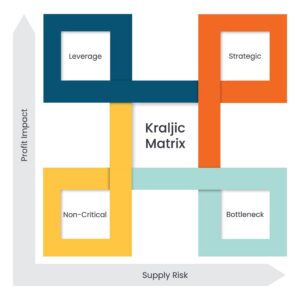 Given these challenges, practitioners consistently advise a pragmatic approach: start simple, be clear on objectives, and build over time. Our respondents unanimously agreed, too, that supplier segmentation frameworks are valuable starting points, but cautioned that they should be tailored to the organisation’s context and priorities rather than applied rigidly. For instance, while 70% of respondents had used frameworks purported by educational and professional institutions (like Chartered Institute for Procurement and Supply) such as the Kraljic matrix and other third-party proprietary frameworks, 30% worked with or helped develop custom internal frameworks (see ‘Kraljic Supplier Segmentation Matrix’ below; Vecteezy, 2026). In a follow up question inquiring after framework recommendations, our respondents doubled down on a tailored approach, insisting frameworks “should be used as a ‘starter’” to build one’s own supplier segmentation framework. Respondents advised businesses to layer category and market expertise / intelligence on top of a framework (like Kraljic) to design a bespoke model for the specific business.
Additionally, respondents agreed that early segmentation efforts should focus on a small number of critical suppliers, with clear criteria, governance, and stakeholder alignment in place. Rather than aiming for perfection, the emphasis should be on creating a usable model that evolves, ensuring segmentation remains practical, relevant, and embedded in day-to-day procurement activity.
While valuable, frameworks are only effective if routinely utilised and reviewed. In other words, our respondents cautioned teams must have a consistent communication schedule with key stakeholders involved with suppliers – including Procurement, Finance, Compliance, and other internal stakeholders within teams like Marketing or IT that perhaps spearheaded or manage to a given supplier relationship.
We asked respondents, ‘How frequently should supplier segmentation be reviewed or updated?’ and their feedback was clear. 50% agreed businesses need to schedule biannual reviews and updates, with 30% of respondents doubling down on the importance of regular reviews – 1/3 of which advocate for continuous reviews and 2/3 purporting quarterly reviews. This strong emphasis on regular reviews reflects how quickly supplier criticality can shift—requiring organisations to reassess and adapt their segmentation on an ongoing basis.
Case Study
Interestingly, all respondents agreed the greatest benefit of supplier segmentation is managing and mitigating risk. 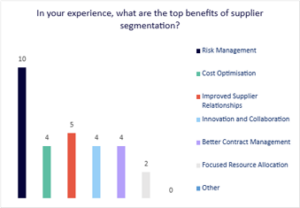
This point was later accentuated when asking respondents to share an example of where supplier segmentation delivered measurable value. One respondent reflected on a project for our client, Beckett’s, where supplier segmentation contributed to a measurable reduction in risk for this large UK-based food manufacturing business.
EBIT achieved risk reduction through more deliberate consideration of factors such as dual sourcing for critical packaging and the ability to flex production via system-enabled demand routing within logistics.
Beyond structural changes, the act of segmenting suppliers and defining tailored strategies also sharpened focus on key risks and issues. It created a clearer framework for engagement, encouraging more frequent and purposeful collaboration between the organisation and its most critical suppliers, ultimately strengthening joint problem-solving and resilience.
Looking Ahead
Both the survey findings and wider research point to supplier segmentation becoming increasingly dynamic, data-driven, and sustainability-led. Respondents consistently viewed AI as an enabler rather than a decision-maker, highlighting its ability to deliver:
- faster results
- reduce manual effort
- incorporate a broader range of data points into segmentation
This aligns with broader research demonstrating AI analysing large datasets in real time, enabling more responsive and predictive supplier management, including segmentation and risk assessment (PwC, 2025; Osewe and Wanyonyi, 2026). In practice, this suggests a shift from static, periodic segmentation toward continuously refreshed models, where supplier classifications evolve alongside performance, risk, and market conditions.
At the same time, ESG is emerging as an increasingly important, though still developing, dimension of segmentation. Survey responses reflected this nuance, most respondents rating ESG as important or very important, but not yet a primary driver compared to risk, spend, or strategic importance. However, external research indicates this balance is likely to shift. A significant proportion of a company’s risk exposure and environmental impact sits within its supply base, making supplier-level ESG visibility critical for resilience, compliance, and long-term value creation (McKinsey, 2021; ESG Supplier Engagement Guide, 2025). As regulation and stakeholders increasingly embed ESG into their requirements and expectations, segmentation models will need to expand to include sustainability performance, ethical standards, and transparency alongside traditional criteria.
The convergence of these two trends is particularly fascinating. AI increasingly enables organisations to operationalise ESG at scale, ingesting fragmented sustainability data, monitoring supplier performance continuously, and embedding ESG insights directly into procurement decision-making (GEP, 2026). This creates the foundation for a future where supplier segmentation is no longer a static classification exercise, but a living, intelligence-led system that reflects both commercial and societal priorities in real time.
For organisations, the implication is clear: the future of supplier segmentation is not just about adopting new tools or adding new criteria, but about building a capability that can evolve alongside changing data, risks, and expectations. EBIT sees tremendous opportunity to partner with organisations and design, implement, and continuously refine segmentation approaches that are both practical today and ready for what comes next.
Citations:
ESG Supplier Engagement Guide (2025) The Complete Guide to ESG Supplier Engagement. CDN. Available at: https://cdn.prod.website-files.com
GEP (2026) How Agentic AI Is Transforming the Future of ESG Research. GEP. Available at: https://www.gep.com
Kodiakhub (2025) Supplier Segmentation: Models, Criteria, and Best Practices. Kodiakhub. Available at: https://www.kodiakhub.com
McKinsey & Company (2021) Buying into a more sustainable value chain. McKinsey. Available at: https://www.mckinsey.com
Osewe, P. and Wanyonyi, R. (2026) ‘Role of Artificial Intelligence in Supplier Relationship Management Decision Making’, IJRISS.
Procurement Journey (n.d.) Segmentation. Procurement Journey. Available at: https://www.procurementjourney.scot
PwC (2025) Reimagining category management with Artificial Intelligence. PwC. Available at: https://www.pwc.com
Vecteezy (2026) Vector illustration infographic of a Kraljic matrix for business procurement. Vecteezy. Available at: https://www.vecteezy.com/vector-art/15196838-vector-illustration-infographic-of-a-kraljic-matrix-for-business-procurement