
What is indirect procurement?

by | Jun 9, 2022

A company’s procurement function can be split into two parts: direct and indirect procurement. What’s the difference, and does your business have a firm handle on both types of cost?

What’s the difference?

Direct procurement is the sourcing of goods and services that will be sold to a customer. This will normally be a core focus for procurement and supply chain teams. As a business focused on selling a product or service this is where your expertise can make the most significant impact.

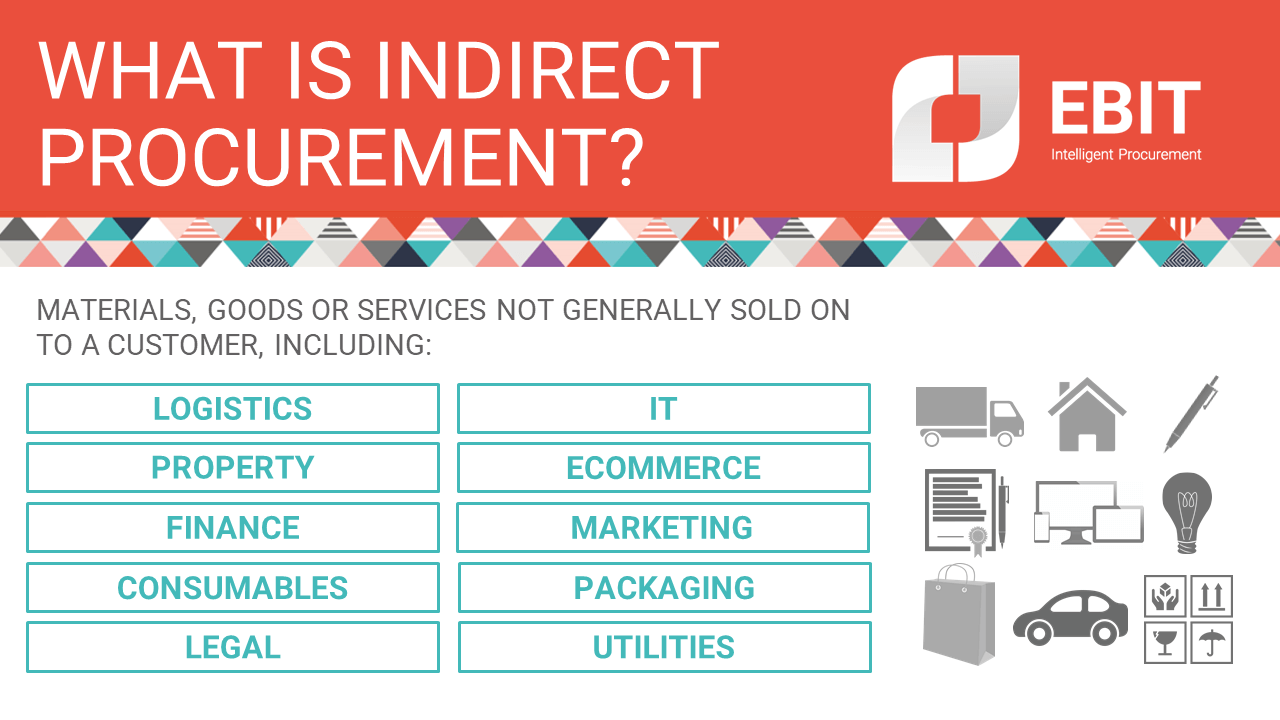
Indirect procurement is also referred to as GNFR or goods not for resale. This is the procurement of materials, goods and services that are used internally in a business and are not sold to a customer.

For the average business, indirect spend is between 30 – 40% of turnover. When fixed costs such as rent, rates, and salaries are excluded, c.15 – 20% of turnover remains as addressable spend. This is where costs can be substantially reduced without a dramatic structural impact on the business.

To illustrate, let’s look at an example of a restaurant chain.

Direct spend categories include:

  • All ingredients that make up the menu
  • Drinks sold at the bar

Indirect spend categories include:

  • Restaurant fit-out: tables, chairs, wallpaper, lighting, toilets, signage
  • Technology: software and hardware
  • Ecommerce: online marketing, email distribution, digital creative material and services
  • Payment gateway fees: in person via a card machine and online
  • Cash collection
  • Marketing: leaflets, posters, magazine ads, social media campaigns, television and radio
  • Print
  • Logistics: food deliveries from depot to restaurant sites, inbound freight of ingredients
  • Consumables: take-away packaging, glassware, stationery, toilet roll, hand soap, PPE, paper
  • Facilities management: repair & maintenance services, cleaning, waste, pest control
  • Security: security guards, CCTV, alarms
  • Utilities: electricity, water, gas
  • Professional services: legal, HR, insurance

This demonstrates the broad range of indirect categories in a restaurant example, however, the indirect spend categories are applicable to all industries.

As you can see from the example above, indirect procurement is very broad-ranging. This can mean that smaller Procurement teams lack the specialist knowledge across all categories. The cost of bringing in additional in-house expert resource to plug these gaps is prohibitive.

Additionally the involvement of multiple stakeholders  makes it complex for internal procurement teams to manage alone.

That’s why, at Ebit, we work with our clients to significantly reduce indirect spend. We’re self-funded: our job is to generate money back to your bottom line and we always deliver a substantial return on investment.

Our expertise has been applied across retail, leisure, charities, manufacturing, food & dairy and technology businesses (to name a few) and can be leveraged to ensure you are achieving best value in any or all of these indirect areas.

Next steps

Get in touch with us now and take the first step toward transforming your procurement expectations.

Are you looking to drive value to your business? It may be to offset increasing costs elsewhere or to free up time and budget to focus on your strategic goals. If you recognise that improved procurement practices and performance can be a driver to this, we would love to talk with you, understand the challenges you face and the opportunities these bring to drive your business. Our average client ROI remains 5:1.

We’re proud of the clients we work with and the projects we have completed. The savings and service improvements we have delivered have helped many companies add value to their bottom line. Our average ROI remains 5:1 across our client engagements. If you want to find out how we can make a difference to your business start the conversation.

More to Explore

Oct 08 2026

Meet the Team: Michelle Walton

There is a real collaborative feel within the EBIT team and you quickly feel that you belong.

Sep 28 2026

Spend Category Trends for 2026: Where Procurement Leaders Are Cutting Costs to Protect 2027 Margins

The organisations best positioned for 2027 are unlikely to be those that simply cut the deepest. They will be the businesses that use...
Sep 23 2026

We Went Into Business To Provide Procurement Services. Chances Are You Didn’t

Chances are you went into business to develop products, serve customers, grow revenue, innovate, manufacture, advise, build, operate or...
Sep 21 2026

Do You Remember…Why This September Could Change Procurement Forever?

The proposed EU Public Procurement Act is more than a regulatory reform. It is a signal. A signal that procurement is becoming more...
Sep 16 2026

Procurement is No Longer a Back-Office Function. It’s a CFO Priority

Procurement is no longer just a purchasing function. For CFOs focused on margin protection, governance and resilience, it has become a...
Sep 14 2026

Ethical Sourcing and Sustainability in Procurement: Creating Lasting Value Through Intelligent Procurement

Ethical sourcing and sustainable procurement are no longer compliance-driven activities. They have become strategic imperatives that help...
Sep 09 2026

Scaling Procurement Capability Without Increasing Headcount: A CEO’s Guide to Sustainable Growth

Discover how CEOs can improve procurement performance, strengthen supplier governance and support growth by scaling capability rather than...
Sep 03 2026

Luxury Retail Driving Value Through Suppler Segmentation

Ethical sourcing and sustainable procurement are no longer compliance-driven activities. They have become strategic imperatives that help...
Aug 24 2026

Innovative Procurement Technology Investments: Creating Capacity, Savings, and Stronger Supplier Relationships

The most innovative procurement organisations are no longer investing in technology simply to process transactions faster. They are...
Aug 20 2026

The Procurement Implications of Major Logistics Disruptions 

The cheapest supplier is not always the lowest-risk supplier. As logistics disruptions become more frequent, procurement leaders are being...

Start your
improvement journey